

Written By: Gardner Tarlow
For those of us who had hoped that Honda would have continued to implement small incremental changes to the 26 Honda CRF250R, no such luck. The reality is that most motorcycle brands do not make changes every year and bold new graphics don’t count. For the 26 Honda CRF250R, this should have been Honda’s head line as the 26 bike is a carbon copy of the 25 version. That’s not to say that a 26 Honda can’t put you on the podium just because it hasn’t been updated in the last 12 months. The 25 Honda had a slew of upgrades and this put Honda well within the zone to be a 250-class winning bike in 25 and this continues for 26. I’ve really enjoyed riding the Honda and although the red bike smacked me around a bit, I can still appreciate a good bike regardless of its color.
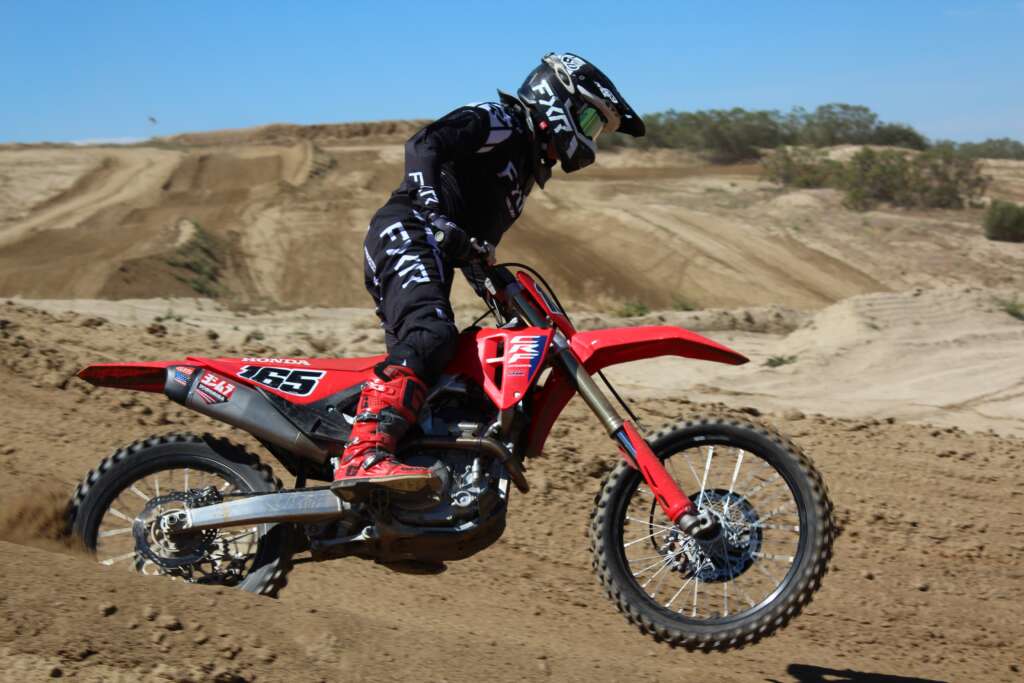
Having spent the last few years riding all the Austrian brands, I asked Kris if it was possible to ride more of the Japanese (aluminum chassis) brands for 2026 season. To my luck or dismay, Kris hooked me up with the 26 Honda CRF250R in early September. I managed to get a number of good days breaking in the Honda and trying out a Yoshimura exhaust before leaving to Ironman Motocross of Nations in October. A big shout out to my good friends Evan, Aaron and Rob and the hook up we had from Aaron and Octane Outlet at the MXoN. If you’ve never been to an MXoN, it’s an outdoor national on heavy steroids. Anyway, after MXoN weekend we packed it up and drove back to Mason, MI. to ride Evan’s private track on 20 acres. To my dismay, less than 1 hour into day one of 3 days of moto vacation, I destroyed my humerus and shoulder trying to figure out a few new jumps. Ironically, it was on a 25 Honda CRF250R-WE that kicked my ass. Regardless of how or why this occurred, if you’re reading this article and wondering why it took 5 months to write, this is my excuse. Check out Racer-X video from Keefer for original video footage posted in early September 2025.
Going back to my first few rides on the 26 Honda, it left me with both a smile and frown on my face. Having spent the last few years predominantly on Austrian steel frames, the Honda frame (much improved from 2024) felt more rigid compared to previous steel frame bikes during my first few rides. Early on I struggled with harshness in my forearms (not arm pump) that was not present on my steel frame bikes. As I slowly got the suspension dialed in, the chassis started to improve but was still less than optimal. Having ridden the 26 Honda CRF250X and using the same modified torque settings on the CRF250R, the chassis became more comfortable and compliant. This is not as comfortable as the steel chassis with all the appropriate tweaks, but very manageable. See torque settings at keeferinctesting.com provided for the 24 Honda CRF450R base setting and mods. These settings transfer to the 25 and 26 Hondas. I used all modified torque settings with the exception of Triple clamp pinch bolts which I went even lighter on torque settings. Stock upper/lower pinch bolts 22/20Nm, KK recommendations 19/16nm and I personally liked 16/12Nm. These torque settings for myself resolved my forearm issues and made the chassis more compliant and less harsh overall.
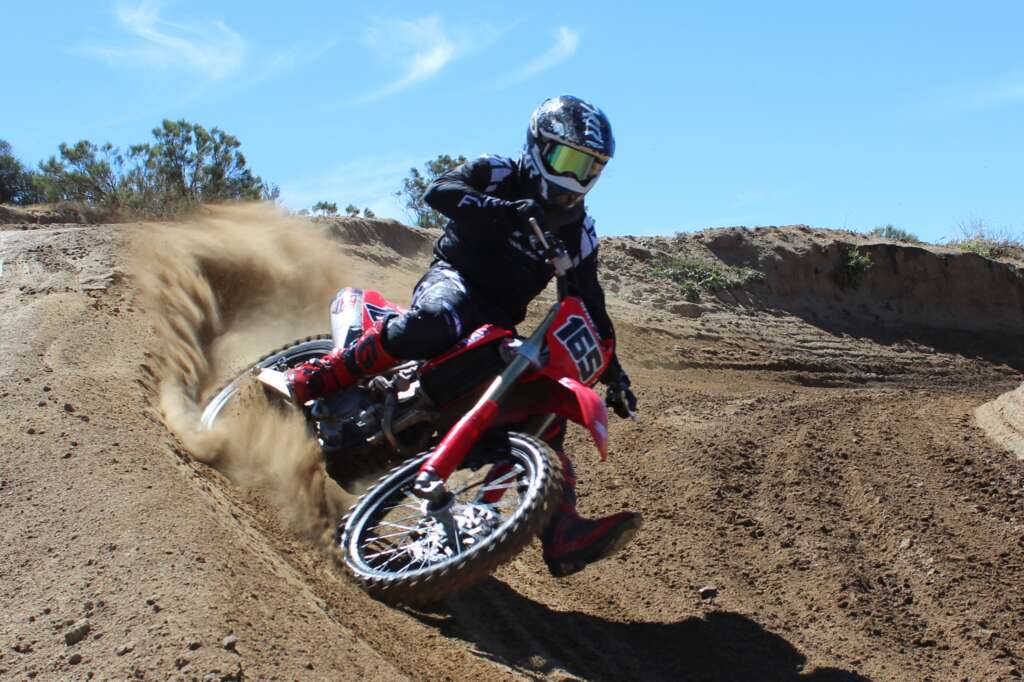
Hondas have always been renowned to be great cornering bikes and indeed this bike does not disappoint. This chassis seems to want to just lay over and rail around corners. My biggest cornering issues have always been finishing the exit of the rut or area 3 of a rutted corner. The Honda feels comfortable on edge of tire entering area 1 of corner and lays over well into area 2 (mid) of the corner but I’m most impressed with how well the Honda wants to stay down in the rut in area 3 and finish the corner. Flat corners and even slight off camber cornering also feel comfortable and confident. The torque settings discussed above provided significant improvements in overall handling and tire on edge feel. The stock Pirelli is a good tire but loses that confident front end feeling as it wears around the 8-10-hour mark. The tread still looks good but it starts to lose that confident feeling and gives little notice when it is going to break loose. I personally like the Dunlop 3S front tire as it tracks very well, makes me feel like I’m on a slot car track and performs well on edge of tire with a consistent predictability if it’s going to break loose or slide out.
The suspension on the Honda seems very balanced and despite being on the heavy side for the suspension (5’10”, 185lb) it still performs well. I do believe that the rear of the bike squats minimally due to my weight and stock spring rate and that a stiffer spring may improve the cornering even more by eliminating any squat effect under acceleration. The fork spring and valving seem close for my weight and speed, however fast intermediates or those north of 180 like myself will need to consider re-valve and springs. If this was my personal bike, I would purchase stiffer fork and rear springs at my first service. When I first tested the bike, I had fork height at 5mm and I felt the bike turned very well but had a bit of head shake or busyness under braking coming into corners. Kris advised dropping the fork to 2mm or flush. Dropping the fork to 2mm and eventually flush was an improvement in both cornering and stability. It is not too often that I run my forks flush on any bike but this bike likes to be elongated and this addressed the busyness under braking and did not hurt the cornering. My current stock suspension setup are Forks at 2mm, 10C, 12R. My rear shock is at 105 sag, 1-1/3HS, 9LS, 8R.
In stock form the Honda on Dyno test is down some 3-4 HP by some reports, however the bike on the track does not feel slow. The Honda has a good front side bottom end and although it may not be as strong as the Yamaha it seems to have more grunt than the Austrian bikes. The Honda pulls well from bottom end into the mid-range and does not give up much to any of the other brands. From mid-range to top end the Honda can hold its own but this is the area of the motor that could use a bit of help to be a class leader.
The Honda has the Honda Selectable Torque Control (HSTC) with 3 levels of traction control, these can be accessed by using the green button on the left handlebar controller. This changes the rear wheel torque from 1-low, 2-medium and 3-high. The stock setting is on level 2 to provide a happy medium between both good traction tracks (1-low) and poor traction tracks (3-low). I have not attempted to play with this button as I have been riding on GH or Cahuilla which fall in to the zone 2 traction zone.
The Honda motor provides three different variances of map choices via the blue button on the left handlebar controller, level 1, 2 and 3. Level 1 and 3 are the stock-1 and aggressive-3 settings and level 2 is the smooth map. Level 2 feels like something you might use if you happen to find yourself on a slippery tight trail. This map might also be appropriate for a younger rider transitioning to a 250. I liked both map 1 and 3 but primarily used level 3 with the stock exhaust.
Lucky for me Kris hooked me up with the Yoshimura RS-12 exhaust and this really woke up the Honda across the boards with both front side bottom end, mid-range and top end over rev performance. This Yoshimura exhaust not only looks and sounds amazing it also provides 2+ HP making this Honda feel very fast. With the Yoshimura pipe both ECU maps 1 and 3 perform very well. Map 1 has a bit more linear power with good over-rev and Map 3 more bottom and mid with ample over-rev. Map 3 runs very strong and the few other riders who swung a leg over the bike all thought it had more modifications than just the Yoshimura pipe. With the Yoshimura pipe I preferred Map 1 in general but Map 3 might be preferred for deeper soil tracks.
It would be nice to try a dual injector and vortex ECU against the Yoshimura exhaust. I imagine the dual injector and ECU would outperform the Yoshimura exhaust but once combined together, performance could be impressive.
So what do I really think? The contrast between steel and aluminum frame bikes can be significant. I do believe I prefer steel frame bikes in general but the Japanese bikes have a lot to offer. The Honda package has certain benefits that all brands have been chasing for decades and that is cornering prowess. The Honda has addressed its straight-line stability while maintaining its ability to corner like a cheetah. In Stock form it may not be a class leader in power but it’s a lot easier to make a slower bike fast than it is to make a poor handling bike turn well.
