

While we all love burning laps at the local motocross track or shredding trails all day, there comes that time at the end of the day when we have to load up as the sunsets over the horizon. We go home with our heads hung low, dragging our feet, moping around the house all night in anticipation of the sun rising, giving us just enough light to be able to hit the track or trail again the following day. While NiteRider did sent us a couple lights to check out, I actually fell in love with the company just after my wife and I had our son Oliver in 2019. My wife worked nights which made her sleep schedule way off and instead of taking bike rides during the day, we found ourselves going on a lot of night rides. When I came across NiteRider lights I got two of their simple handlebar lights and it was off to the races; well not the races, more like off to the sidewalks of Riverside and trails of the So Cal desert.
Being that they are re-chargeable, I still have the two original ones I bought, but when NiteRider reached out and asked if I wanted to test a couple of their higher performance lights I was excited to put them to the test. Since my son now has a KTM E3 (thanks to Kris) I was excited to now be able to put one on my sons helmet and do some night riding of our own.
Lumina Micro-Moto 950
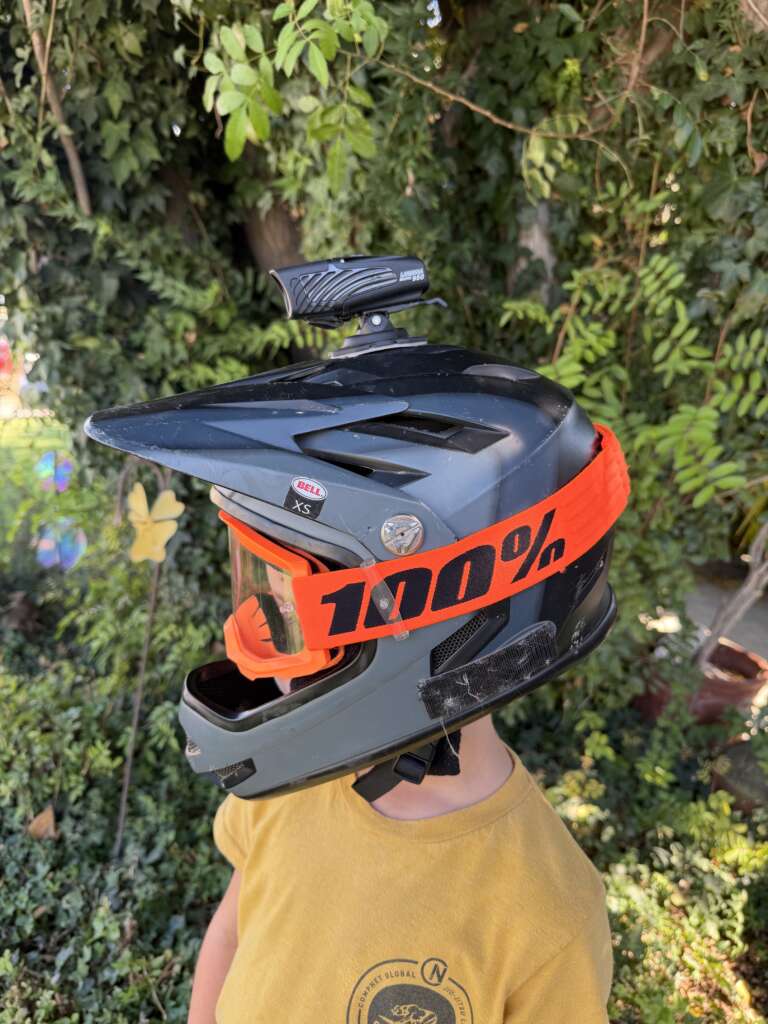
The smaller of the two lights that NiteRIder sent was the Lumina Micro-Moto 950 with stick on helmet mount. For me this is the perfect light for a multitude of applications as it has five different power settings; low (13hr run time @200 lumens), medium (5hr run time @425 lumens, high (2hr run time @950 lumens), walk (41hr @50 lumens) as well as a flashing setting (14hr @950 lumens) which can be handy if you are trying to get someone’s attention from far away. Depending on what charger you use and how dead the battery is, charge time varied between 2 ½ to 4 ½ hours and uses a USB-C charge port which is nice because it’s such a common charge cable. The 950 is very compact since the battery is built in and very easily clips onto the helmet mount easy enough for my 7 year old to find it with gloves on top of his helmet to put on or take off. Being only 140 grams the light is barely noticeable when mounted on a helmet, even when mounted on the side of the chin bar. While having the lower setting are nice for battery life, we tended to use the light mostly on the high setting because most rides don’t last more than 2 hours and let’s get real, more light is better than less. That being said I did use the lower setting when riding in the city so as to not blind oncoming pedestrians or vehicles. In addition to my son using it for our evening adventures, I also found myself using it on my mountain bike helmet for night time e-bike rides. The beam seems to be a good mix of a spot and flood, providing a balanced pattern while providing plenty of light for lower speed technical riding and enough light to feel comfortable when speeds pick up on smoother trails (or sidewalks).
Although I never had an issue with the light itself, I did have a small problem with the helmet mount. This wasn’t the fault of NiteRider, it was actually the fault of a clumsy 7 year old boy. My son had the light clipped onto his helmet and when we got to the park, he dropped his helmet right onto the light and the small clip that secures the light to the mount broke off. Once the clip was broken, it allowed the light to freely slide in and out of the mount so I ended up taping the light in place for the remainder of the ride. When I contacted NightRider they informed me that the mounts are warrantied and promptly sent me a new mount, and after having a fatherly conversation with my son has been flawless ever since. For full sized bikes this light isn’t going to win the Baja 1000 at night but I think serious night riding it’s a great option to use in addition a powerful bike headlight. That being said, we all have that group of buddies that tend to turn a “fun” trail ride into and all day suck fest which more often than not continues into darkness. For only $74.99 this is a great option to have a mount pre mounted on your helmet and throw the light into your camel pack to use when things get dark, trust me; all your friends who are pinging off every trailside rock in the darkness will be wishing they had one.
Pro 4200 MX With Jaw Bone Mount
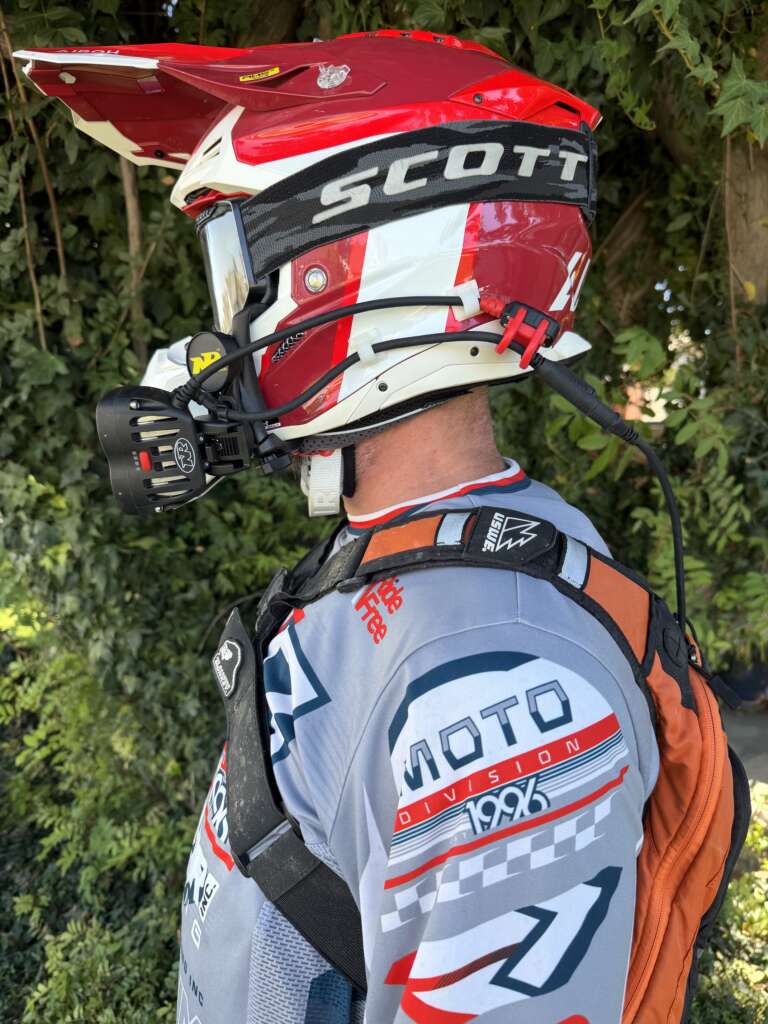
The 950 may not be the light of choice for high speed off-road riding or racing, but the NiteRider 4200 MX Enduro on the other hand is a serious light with some serious power. The 4200 comes with everything you need to hit the track or trail including; light, remote switch (attached to light), battery, 36” cord extension, pigtail for wiring the light directly to the bikes battery, chin bar mount and 110v charger. The 4200 cones with four power settings; low (6hr run time @1,000 lumens) medium (3.5hr run time @2,000 lumens) High (1.5hr run time @4200 lumens) and “Race” which is for endurance races where the light isnt as bright but lasts longer than you’ll ever want to ride (16.5hr @600 lumens). In addition to the power settings, the 4200 also has three different flash settings; Flash (16.5hr @1400 lumens) Beacon (16.5hr @1400 lumens) and S.O.S. (16.5hr @1400 lumens).
In my opinion, this light is for the rider who goes on rides that are for sure going to end up in darkness, but it’s especially for the rider who is going to be racing at night, whether it be a local Grand Prix or even racing in Baja. I have done my fair share of night riding and racing and can say without a doubt that having a helmet light in addition to a light mounted to the bars is a huge benefit. While having a good bike mounted light is obviously beneficial, it limits you to only being able to see where the bars are pointed. Having a bright, helmet mounted light gives you the ability to lift your head up and look further down the course, scan the surrounding terrain, look down at your bars or whatever instruments you may have, and most importantly it gives you the ability to see when you are off the bike, either at a pit, diagnosing trailside issues, or god forbid, finding your bearings after a crash. Since I tend to like riding technical terrain, the other thing that’s great about a good helmet light is being able to see when clearing trail debris like downed branches or checking the viability of a trail obstacle.
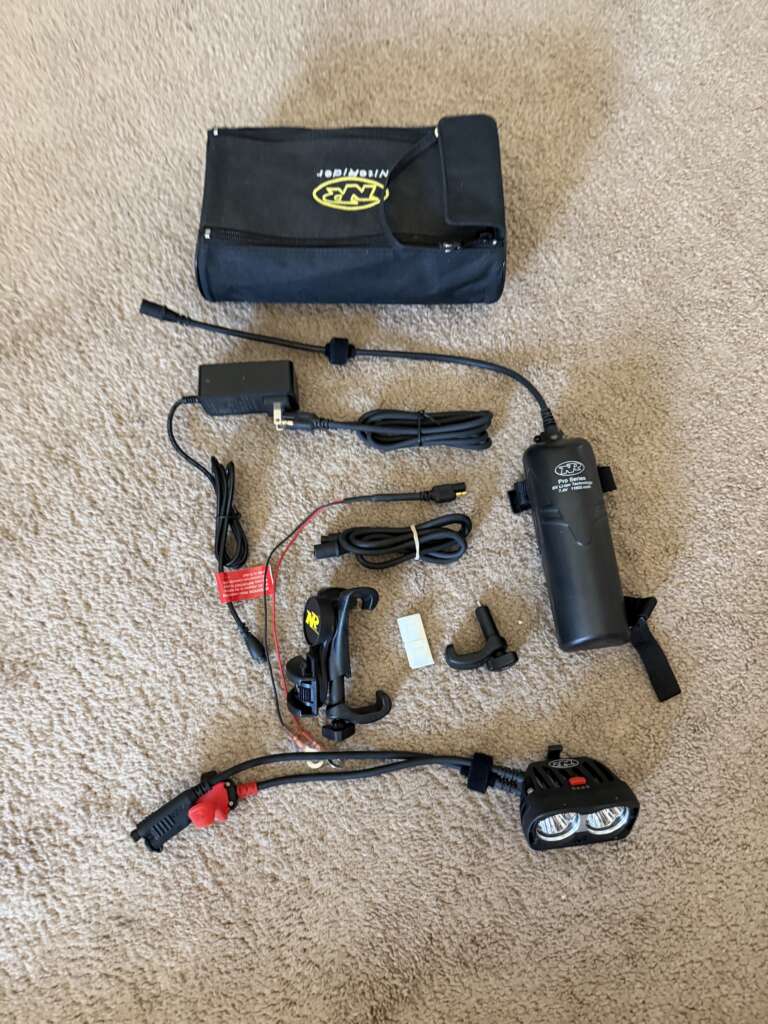
Setting up the 4200 chin bar mount is pretty simple and straight forward. The kit comes with the mount as well as an extra clamp and screw in addition to a couple sticky wire mounting clips to cleanly route the wires along your helmet and into whatever pack you carry the battery in. The light comes with two buttons, one on the light itself and the other is on a 12” wire extension that comes off the light with a rubber strap that allows you to attach it to the side of the helmet which makes toggling between settings easier without the possibility of making the light out of adjustment by toggling the button on the light itself. I found that in my smaller camel pack I don’t necessarily need to use the 36” extension cord as the pack sits high on my back and the light pigtail and battery pigtail is long enough to not get tight unless I looked straight down in which I could feel slight tension on the cord. In a perfect world, the battery cord would be about 2” longer so I would never feel tension and never needed the 36” extension cord. The other cool part about the 4200 is that NiteRider sent me a pigtail to connect the light to the battery of a bike (if the bike has a battery) so that it can be powered up no matter how long the ride is without the fear of the light battery dying.
The Jawbone mount was very easy to install on my helmet (I mounted it on an Airoh helmet). I mounted the light on the left side of the helmet because I noticed that if it was mounted on the right side, the cord pigtail that comes out of the light stuck down and could potentially interfere with my chest protector when I was moving my head to look around. I like the remote switch because if I used the button on the light itself it had the tendency to slightly move the light and make it out of adjustment. Also the remote switch mounted cleanly on the side of my helmet and was easy to toggle. Each power setting definitely has its own purpose, the lower settings are good for slower riding or when stopped and just need light to walk around, where the higher settings are perfect for when speeds pick up and I needed to see what was in front as well as what was around me. This is the first helmet light I’ve used that didn’t leave me wanting more light, on the highest setting I was always able to see whatever I pointed my head at. While it wasn’t a 10lb dumbbell I definitely noticed having the light mounted on the chin bar (the light and jawbone mount weight 344 grams), that being said after about 10 minutes of riding I was able to compensate for the added weight without giving it a second thought. Since I already have water and tools in my camel pack, the added weight of the battery was less noticeable and like I said before the cord only got tight when drastically turning my head when stopped or off the bike
While this light is a tad on the pricy side ($500) if you are thinking about doing some serious night riding or racing, I can’t imagine wanting any more light. I tended to use the high setting for any time I was riding because in terms of light at night, I feel like more is always better. That being said, there were two instances where I used the lower setting, one when my riding buddy broke his lever and we replaced it on the side of the trail, and the other clearing brush off the trail to clear a path. I also tested the strobe function on a night ride close to home, I found myself on top of a hill overlooking Riverside and I called my wife and asked her to look up at the hill and see if she could identify my light flashing and she could in fact see it flashing from roughly 4 miles away. If you’re serious about riding after the sun goes down I’d definitely recommend looking into the NiteRider 4200, because there is no such thing as too much light when twisting the throttle after dark.
