

Written By: Gardner Tarlow
Let’s be honest, the Austrian brand KTM as well as Husqvarna, do not have an entire industry of high tech 150cc machines out there competing for king of the small bore enduro class. Even without that competition, it’s very evident that KTM and Husqvarna are without a doubt the training tools and weapons of choice when it comes to training for hard (moderate) enduro for the older rider or better yet the smaller or younger rider who is looking to become a future enduro champion.
If there was one thing I wish I had done decades ago, it would have been to purchase a trials bike to practice all the skills that could have helped my overall enduro techniques. Could’ve, should’ve, would’ve!
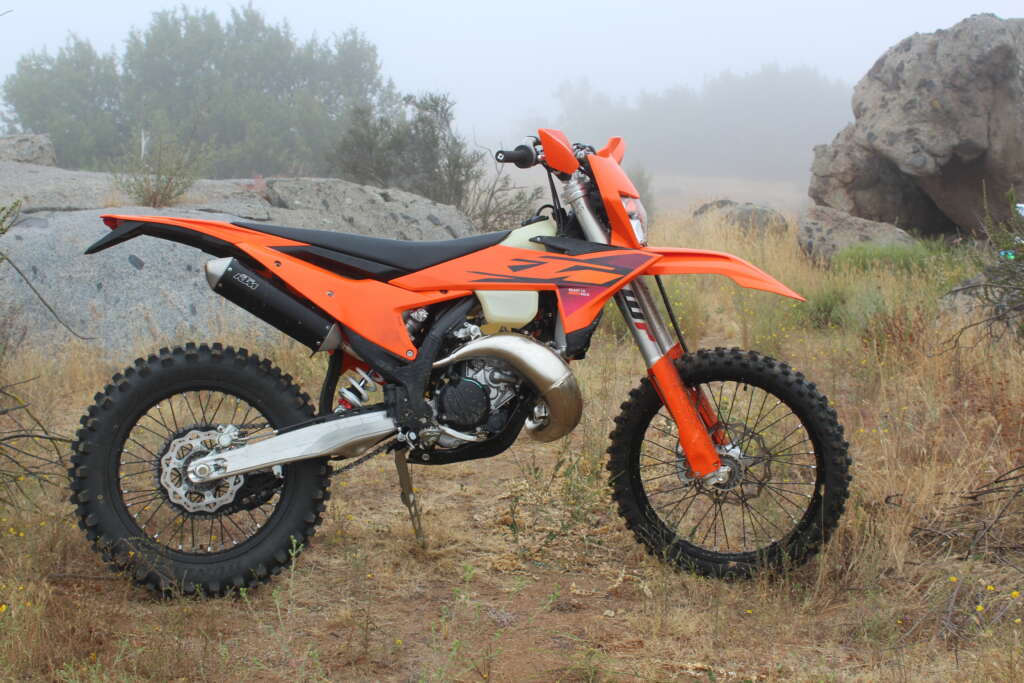
The 2026 Austrian 150 enduro bikes did not receive any major upgrades over the 2024/25 bikes and although I prefer orange over white for my plastics, in general, I prefer linkage suspension over PDS for my rear suspension. PDS bikes are designed for technical riding with rocky trails that require high ground clearance, low weight and simplicity while linkage bikes provide superior progression bottoming resistance and consistent handling at higher more aggressive speeds. Unfortunately for the Orange brigade, there is no longer a 125XC or 150XC linkage cross country bike available for the 2026 year. This rear suspension design is the major divergence in the road of the two Austrian brethren bikes. To PDS or not?
I am a Senior novice/Intermediate enduro rider, 5’10” and 185lb. My off-road/enduro bike of choice is my old smokey, KTM 300XC (linkage). The term old smokey is both a term of endearment as well as a good description of the bike itself. With Kris having so many commitments with factory motocross teams and manufacturers, I’m blessed with the opportunities each year to ride a plethora of small bore enduro and off-road bikes.
Unfortunately, I received the 26 KTM 150XC-W weeks before destroying my right humerus and shoulder in an unfortunate, self-inflicted, moto accident. With that being the case, I have used the 150XC-W as a rehab bike, riding a lot of slow to moderate paced single track with mild elevation changes while trying to recover my previous poor technique and riding skills. With hopes of testing what the 150 might be able to do on some bigger hills I also went up to the high desert to play on some familiar trails that were a bit dryer than optimal but nonetheless a blast on the 150. Last but not least, I headed out to the low desert and although not ideal for the small-bore motor, I really enjoyed the playfulness of the 150 on the razor backs and tight box canyons. Although I do not ride trials, the light, agile and easily maneuverable 150 is a blast to play around on at slow speeds. While in the low desert I also had the opportunity to chase my good friends on their bigger bore bikes. While, I could not keep up the 150 really got after it, and flying across rough, whooped out and rocky desert trails brought a smile to my face.
So, let’s address the elephant in the room, to PDS or not? I can recall back in early 2000 when a good friend of mine allowed me to ride multiple KTMs, all of which had PDS. Mind you, it didn’t matter how good your KTM was set up, it would inevitably do something very unpredictable right when you started to think “This PDS doesn’t suck.” I think it is these bad memories that continue to haunt myself and KTM and the perceived perception of what new generation PDS is capable of. PDS is the ground clearance king for logs and rocks. If you have linkage and a slide plate that extends and covers the knuckle of the linkage, you may think it works as well as PDS but let’s be real, you’re not Billy Bolt, and yes, the PDS does seem to just glide over obstacles extremely well.
KTMs new spring fork on the XC and XC-W are a pleasure to ride. The fork is easy to set up and maintain, the spring provides more comfort than the older air version, it is predictable and has removed that question mark about KTM air forks and stock performance. This KTM I initially set up in stock “standard” factory settings. Shock LS-15, HS-2 R-15, Sag 110. Fork C-15, R17 fork 5mm. My first few outings occurred on tight, slow paced single track, firm-hard pack soil and somewhat slippery conditions. My first impression was just how much fun this bike was to throw around in tight sections and despite my bum shoulder, the ability to place the bike wherever I wanted with very little effort. This is a small-bore bike and should be nimble and it does not disappoint. The suspension is a bit soft for riders north of 180lb but during normal slow-moderate enduro speed single track, it is very plush and balanced. The bike comes stock with Dunlop AT82 tires which perform very well both up front and on the rear. This bike may not be intended for GNCC style racing, but it performs very well at moderate paced single-track speed.
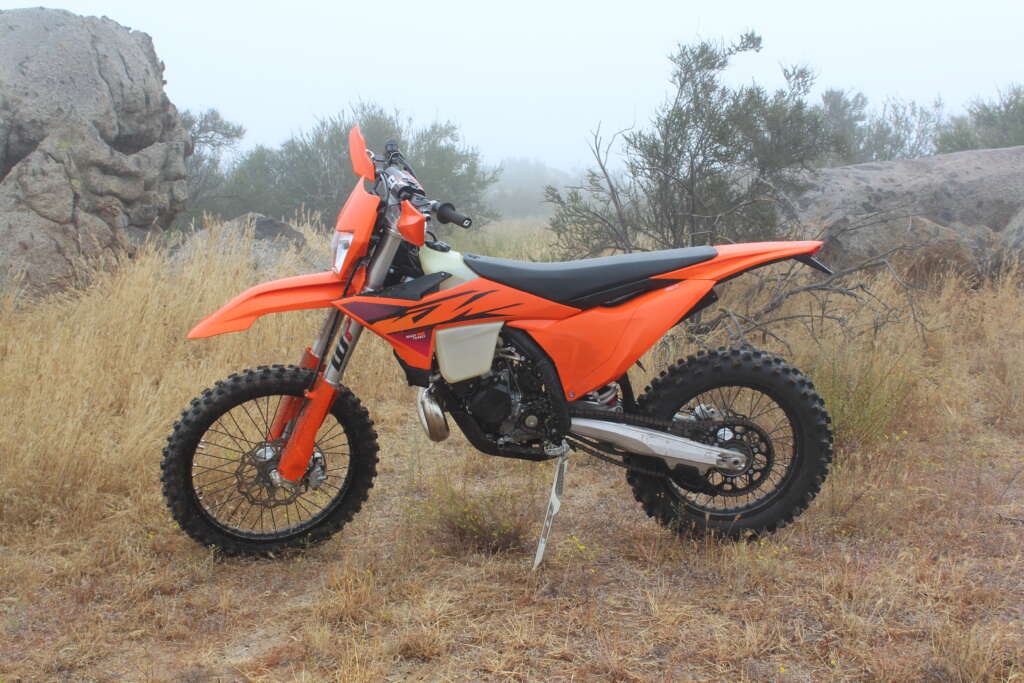
The high desert mountains I ride are a bit more moderate to fast paced single track with some 2-3-foot-wide hard base trails with small rock sections. The 150XC-W even with the standard suspension setup handled the faster pace very well and the ability to throw the bike around and place it wherever I wanted was impressive. With some of the faster pace trails and G outs at the base of merging trails the standard suspension setup was too soft and moved through the stroke with an uncomfortable front-end feel. With my 185lbs, G-outs hit at a faster pace pushed the limits of the stock suspension standard settings. KTM provides comfort, standard and sport settings. Increasing from standard suspension setting to sport settings, Shock LS-12, HS-1.5, R-12, Fork C-7, R-9 absolutely helped higher speed performance and G-outs effects but unfortunately my shoulder in general preferred the slower pace riding and softer setup. In the high desert there are plenty of moderate to large sandy hill climbs and despite the dryer conditions, the 150XC-W absolutely was capable of climbing moderate hills as long as you had a run at the start and just never let off of the throttle. This diminished performance compared to a larger bore bike provides the perfect opportunity to intentionally train using clutch modulation versus rolling off the throttle. You have to find a positive in everything, correct? My friends would argue that at 185lb, I’m too big to be riding a 150 and they are tired of waiting for me as I try to climb said hills.
The low desert of Ocotillo in general is not an ideal destination trip for the 150XC-W and my larger size. The desert was warm, dry, dusty and slippery. Although I enjoyed the razor backs and tight slot canyons, I actually preferred my time on the throttle, racing through the desert chasing my buddies through the woops and tight sand washes. In the tight slot canyons, the 150s abilities to pivot and manhandle even with a bad shoulder made the bike the weapon of choice. I didn’t think the 150 would do well in the open desert and it doesn’t compare to a 300 or 450 but this little small bore is more than capable racing around the open desert. Despite the faster speeds of the desert, I kept the standard setting and the bike handled very well. If higher speeds and aggressive riding is going to be the bikes intended purpose, it would need valving and springs for riders north of 180lb or intermediate off-road speeds. The PDS suspension performed very well in all the different riding conditions I exposed it to and at no time gave me concern.
It’s been a while since I rode one of the original 150 TPI-Transfer port injection bikes. The 150XC-W TBI-Throttle body injection motor is a much more exciting motor to ride than the TPI motor. The TBI has good bottom end grunt and is more than capable for clearing small to moderate obstacles from a dead stop even for my larger size. The bike has a strong pull through the midrange and although may not rev as well as the SX/TC bikes its top end is far more exciting than the older TPI.
I have become very accustomed to hydraulic clutches over the years and some may argue the lack of engagement performance of a hydraulic clutch does not compare with a cable clutch. I do believe that cable clutches have more modulation but the KTM hydraulic clutch has acceptable engagement, modulates well and can handle a lot of abuse without any issues.
I am a dinosaur and really enjoy riding any two-stroke. For myself there is no other enduro bike better than a two stroke. My skills in general are limited with anything above moderate-intermediate enduro. I believe riding a small bore enduro bike allows the rider to try new techniques and skills that for myself seem un-manageable while on a larger bore bike without the acquired skill set. Climbing a big hill on a 150 to me requires far more skill than that same hill on a 450F or 300 two strokes. Whether you like KTM Orange with PDS or Husqvarna White with Linkage you can’t go wrong with either of these 150 products. You decide for yourself which is the better color and training tool that makes you a better enduro rider. Personally, I’ll take whatever Kris lets me ride.
