

Written By: Michael Allen
Since getting started in the motorcycle industry in 2010 as a test rider, I’ve been lucky enough to ride a variety of two-wheeled motorized machines, everything from e-bikes to adventure touring bikes and seemingly everything in between. While they have all been amazing experiences, I have always yearned to try something a bit different and wished I had been around in the 1990s or early 2000s as a tester.
It always seemed interesting to me because I felt as though that was when manufacturers were trying new things, and there were clearly bikes that were better than others. In fact, I sometimes ask Kris to plop me on his knee and tell me stories about the good old days when two-strokes were king, big bores were “secret,” and Yamaha 250Fs had compression release levers.
The reason I like to ask is, first off, because I like to learn about the good ol’ days, but mostly because I felt like, from 2010 to 2020, everyone was producing their own slightly different take on basically the same ideas. You realistically had two choices: Japanese or Austrian.
With that being said, the last three to five years in the motorcycle industry have been very exciting with the addition of Triumph, Beta, and Ducati, brands that historically haven’t necessarily been at the forefront of the off-road industry.
As most brands tend to do, Ducati first released its motocross bike in 2026. Generally, I get the chance to ride bikes when they are first available to media outlets, but having been off the bike due to some personal issues, I hadn’t had the opportunity to ride the Ducati motocross or off-road bike before being invited to the 450 EDS introduction.
In mid-July, I got the official invite to the press launch of the 2027 Ducati Desmo 450 EDS. After having some time off the bike, I was excited not only to be able to test a new dual-sport but also because the introduction was going to be in Mammoth, California. Although I’d driven past the exit more times than I could count, I had never ventured off the highway to check out the town.
I’d heard how much fun the dual-sport trails were and could hardly wait the two-plus months until the introduction date.
While the Ducati Desmo 450 EDS borrows a lot of its heritage from the 450 MX and 450 EDX, I’d say it’s more like a sophisticated third cousin than a brother to the previously mentioned models.
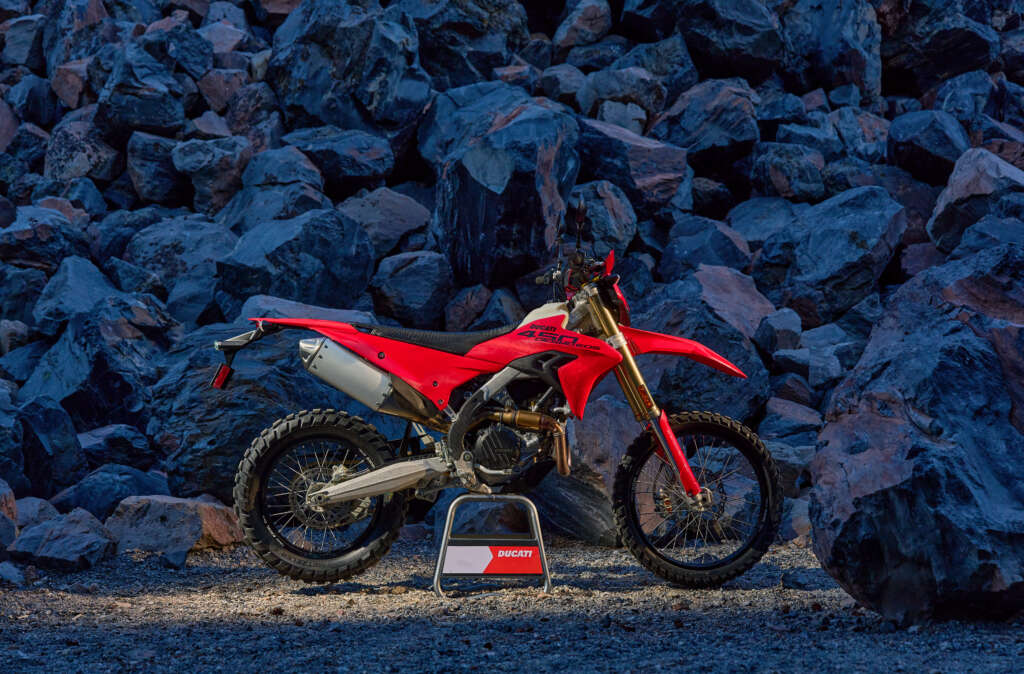
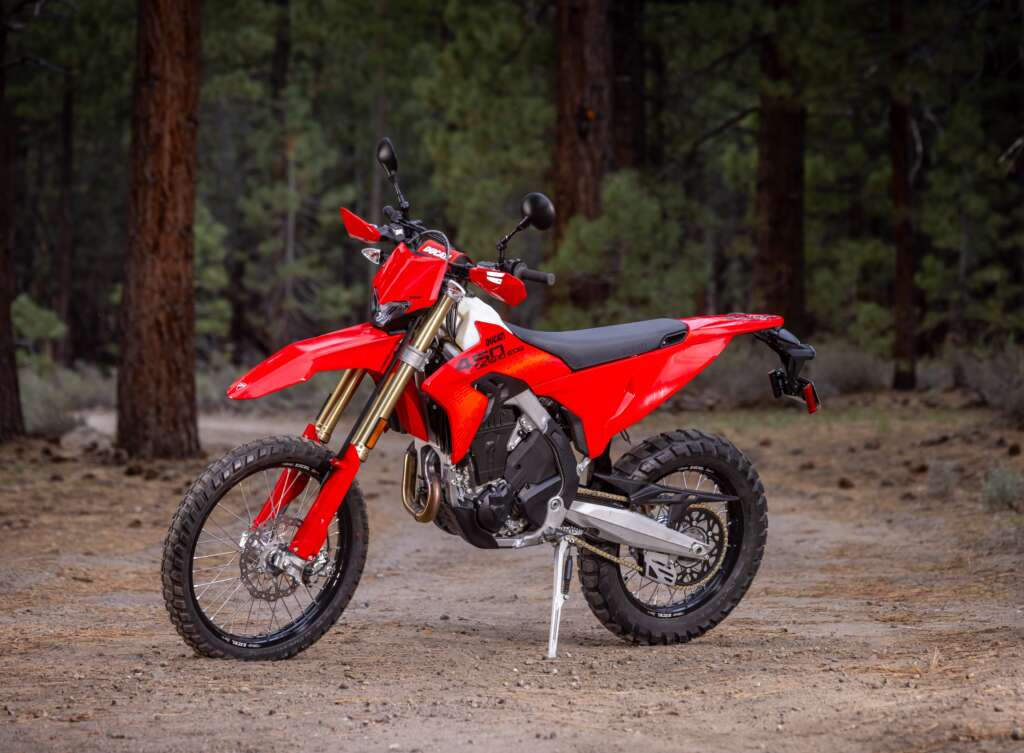
The EDS comes with a 2.25-gallon translucent fuel tank, handguards, LED headlight (as well as taillight and turn signals), larger radiator, fan, skid plate, kickstand, 18-inch rear wheel, Brembo brakes with Galfer rotors, dual-sport tires, six-speed transmission, 195-watt stator, and street-legal muffler, among other things we will get to in this story.
Engine and Power Delivery
I have no choice but to start with the engine because it’s one of the main things that sets this bike apart from others in its category.
The Desmo 450 engine, unlike those from other manufacturers, uses a valve system that doesn’t utilize traditional valve springs. Instead, Ducati uses its Desmo system, which has followers that both open and close the intake and exhaust valves mechanically.
The benefit of this system is that Ducati can use a much more aggressive cam lobe and control the exact timing of the valve closing instead of relying on a spring to return the valve to its seat.
Ducati claims this translates into smoother power, in addition to the bike being able to pull longer into its high rev limiter. They paired this engine with a six-speed transmission, and the power is modulated through a Brembo clutch.
We were given this information during the press briefing, and while it all sounded great, I was excited to see what all the hype was about.
After starting the bike in the morning and letting it warm up, we pulled out onto the highway. I initially noticed that although it was corked up due to emissions restrictions, the EDS was very smooth and wasn’t like some other dual-sports, which sometimes struggle just to run in stock trim.
Our first stint of the ride was on pavement, so it gave me a good chance to run through the gears and learn where the bike liked to be ridden. To my surprise, it didn’t necessarily have a “happy window.” It seemed to pull decently from anywhere in the RPM range.
This became most evident to me when we slowed for a sharp bend, and I didn’t downshift. I kept the bike in fifth gear and rolled on the throttle from about 15 MPH.
When you do this with most other bikes, you get an abrupt “chugging” sensation where, oftentimes, the bike wants to either stall or you feel it surging as it tries to accelerate, in addition to a large amount of chain slap.
The EDS didn’t do either of those things and just smoothly picked up speed higher into the RPM range.
This theme seemed to follow the bike throughout the day, which makes it quite easy to ride because you don’t have to be paranoid about which gear you’re riding in. It’s responsive (within reason) no matter where you are in the RPM range.
Transmission
The transmission on the EDS was one of the things that impressed me most.
As previously stated, it has a six-speed transmission, making first gear lower than on Ducati’s motocross and off-road bikes while adding a sixth gear. The gearing was darn near perfect for every condition.
Sometimes, when manufacturers make a lower first gear, it’s too low and almost unusable. However, Ducati did its homework and made first gear usable for technical riding without giving the bike a surging sensation. It was perfect for hopping rocks and logs.
Pairing the lower first gear with a deep sixth gear made it pleasant to ride in tight terrain while still being able to smoothly cruise at 70 MPH without wringing its neck.
In fact, I saw 93 MPH, and there was still more to be had. I just ran out of road.
In addition to the great gear spread, despite the fact that the EDS does not come stock with Quick Shift, it shifted smoothly and effortlessly, except at wide-open throttle under heavy load.
Suspension
The EDS comes with 49mm SHOWA closed-cartridge forks that are Kashima-coated, as well as a SHOWA shock connected to a traditional-style rear linkage.
Starting with the fork, I thought the spring rate and valving settings were impressive for a dual-sport.
What I mean by this is that most dual-sport bikes come very lightly sprung with even lighter valving, resulting in a very spongy ride that tends to give the rider a seesaw sensation. The front dives deep into the stroke under braking, there’s a lot of rear squat under heavy acceleration, and the bike just has an overall non-performance feeling.
Ducati did a great job of creating a plush ride while still giving me the confidence to charge into big whoops and holes without blowing through the travel.
That being said, I do have one complaint about the fork, which is the top-out feeling.
When going through multiple deep whoops, anytime the fork shoots back out, there is an abrupt metal-to-metal clunk that can be felt in the handlebars. In my opinion, it felt so abrupt that it almost seemed like it would pull the front end back down slightly.
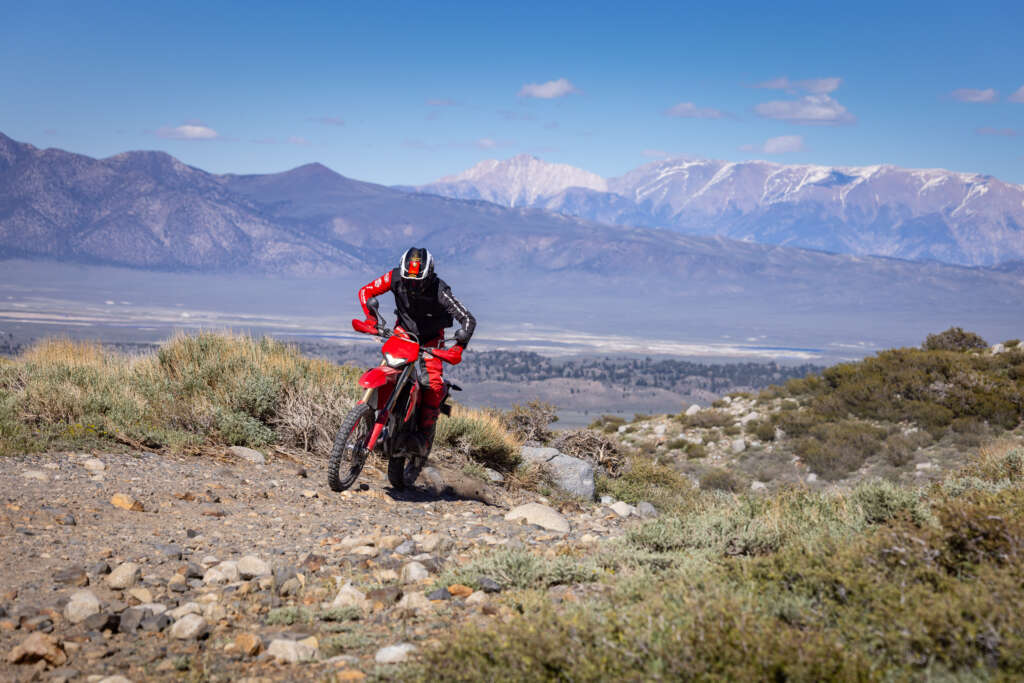
The rear of the EDS worked well in a multitude of terrain and always tracked straight, no matter the speed or depth of the sand and whoops (there was a lot of sand and plenty of whoops on our route).
My only slight nag about the shock was that it seemed slightly undersprung and rode a bit low in the stroke. This is great in a straight line but made the bike ever so slightly more difficult to turn. However, that could also be due to the Metzeler Karoo 4 tires installed on the bike.
I’m not going to put all the blame on the shock because, usually, when a bike rides too low in the rear, you feel a bottoming sensation, and the rear of the bike tends to shoot off to one side, creating a swap. I never felt that from the EDS.
Tires
As previously mentioned, the EDS comes with Metzeler Karoo 4 tires.
Admittedly, I was slightly concerned because I knew I wasn’t truly going to feel the potential of the bike, or at least how it will be ridden once the consumer gets it, since the tires are likely going to be the first thing customers change.
What I found with the Metzelers was that they’re good on the street and decent once the bike is going over 20 MPH, but they struggled in three main areas.
When starting from a stop in sand, I felt like I was riding on a slick until I got some momentum and shifted out of second gear.
The second difficult area was sandy uphills. The sensation I got from the bike was that no matter how much I shifted the bike, my weight, or my throttle position, the EDS just spun and made more dust.
Lastly, multiple times I felt like I had a flat front tire, even pulling over several times to check whether it was still inflated.
With that in mind, it’s a very conservative dual-sport tire that was at least consistent when sliding at speed and didn’t do anything I wasn’t expecting.
Fuel Range, Electronics, and Cooling
Being a true dual-sport, the EDS comes with a larger tank that will get you 60 miles, as long as you aren’t spinning the tire in the sand for hours on end.
It has a low-fuel light that did come on at the end of the ride, but I hadn’t reset the trip meter at the lunch stop where we refueled, so I cannot tell you how many miles were ridden before the light came on.
In addition to a low-fuel light, the display shows speed, hour meter, rev counter, water temperature (more on that in a second), and two trip meters.
While the EDS does come with a fan, I found the limits of the stock temperature reading.
At one of the photo stops, another rider and I started hill climbing and made a sand turn track. After the hill climb, I looked at the temperature, and it said 95°, which was odd to me, but I didn’t think twice about it.
That is, until I was done riding the sand track and looked down to see the temperature read 109° and begin flashing red with the warning “T-HOT!” (TOO HOT!).
It was then that I realized the temperature setting was in Celsius, and the bike was boiling over and spitting some coolant onto the ground.
While the bike is running, the fan will run as long as it needs to cool things down. However, I found that when the engine is shut off, the fan will only run for about five seconds.
I think a contributing factor to the overheating was the large amount of plastic engine shielding covering the sides of the engine to keep engine noise down. In turn, this restricts airflow past the engine, trapping heat.
Additional Features
A few other things I like about the EDS are that it comes from the factory with a skid plate, handguards, frame guards, and a rubber noise dampener around the rear sprocket.
Something I was concerned about, although I didn’t have an issue with it, was that the O2 sensor was on the head pipe, directly in line with the front wheel.The sensor is on top of the head pipe, so theoretically, it’s protected by the bottom of the pipe. However, I can see certain situations where it could potentially be vulnerable.
Ducati Performance Race Kits
Ducati is well aware that the EDS, in stock form, comes very lean and corked up, which is what needs to be done to meet strict U.S. regulations.
That being said, Ducati has multiple levels of “Race Kits” available, which technically turn the EDS into a “closed-course” motorcycle (wink, wink).
The entry-level race kit is called the Ducati Performance Kit, or “DP0.”
This kit costs only $262, adds 9 HP, saves 2 pounds, and comes with a new head pipe (getting rid of the restrictive OE pipe), intake manifold, 13/51 sprockets, and handlebar combo switch.
The switch unlocks traction control, engine-braking adjustments, Ducati Power Launch, Quick Shift, and predictive maintenance, which logs how the bike is ridden and adjusts service intervals accordingly.
In addition to the DP0, there is the DP1 Race Kit ($1,024), which adds 11 HP, saves 4.8 pounds, and includes a titanium Akrapovič muffler.
The final option, the DP2 Race Kit ($1,800), comes with a full titanium Akrapovič exhaust system, adding 12 HP and saving just over 20 pounds.
Traditional service intervals on the EDS are as follows:
- Engine oil and filter: Every 15 hours
- Valve clearance: Every 45 hours
- Piston replacement: Every 90–120 hours, depending on predictive maintenance
- Main engine service: Every 180–240 hours, also dependent on predictive maintenance
Final Thoughts
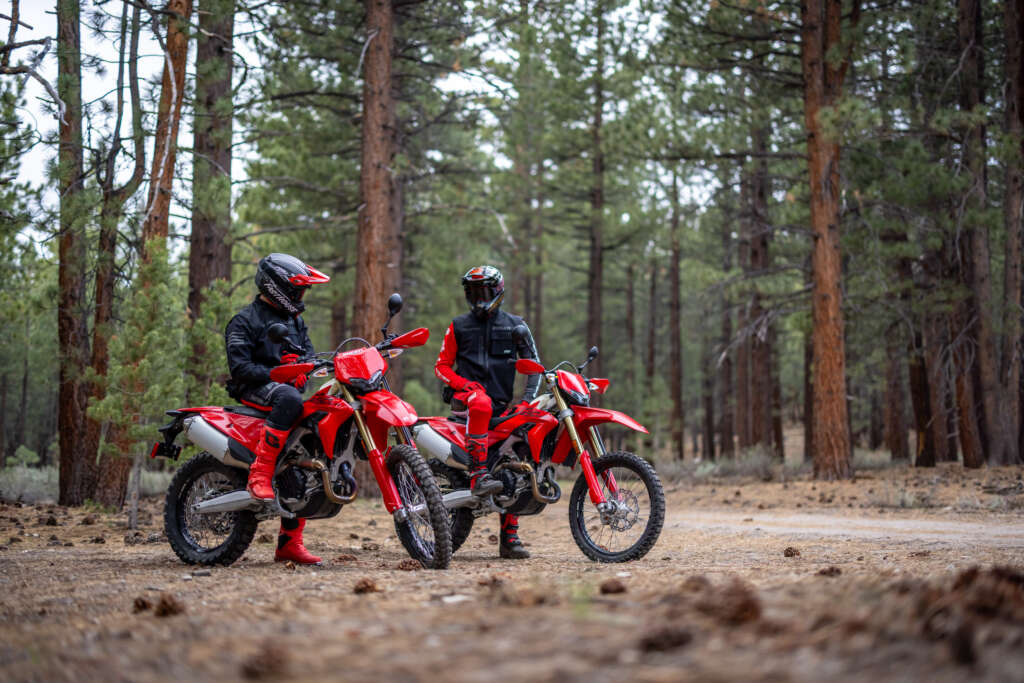
After enjoying over eight hours on the Ducati Desmo 450 EDS, I came away quite impressed. Not because it was impressive for a first-year bike, but because it was impressive, period.
When I heard that Ducati had been open to new ideas and thoughts by seeking opinions from people who actually ride and race off-road at a high level, such as Alexander Smith (yes, Malcolm’s son), I knew they were headed in the right direction.
This may not be testing in the ’90s, when bikes were more clearly better or worse than each other, but it’s a whole new, exciting era of having brands that aren’t necessarily endemic to the hardcore off-road market jump in and mark their territory.
Who knows? Maybe someday I’ll plop my son down on my lap and tell him stories about the “good ol’ days” when bikes first got engine-braking control and predictive maintenance intervals.
