

Written By: Seiji Ishii
There still aren’t many aftermarket parts for the Stark Varg, and the stock foot pegs are already excellent. They are also some of the best-looking OEM pegs I have seen. But where I ride, and the way I ride, I wanted more support and a more planted feeling under my boots.
The Varg doesn’t come with foot pegs that need replacing right away. The stock pegs work well, they look great, and on a bike as clean as the Stark, that matters. I did not swap them because I thought they were bad.
I swapped them because I wanted the bike to feel more solid underfoot.
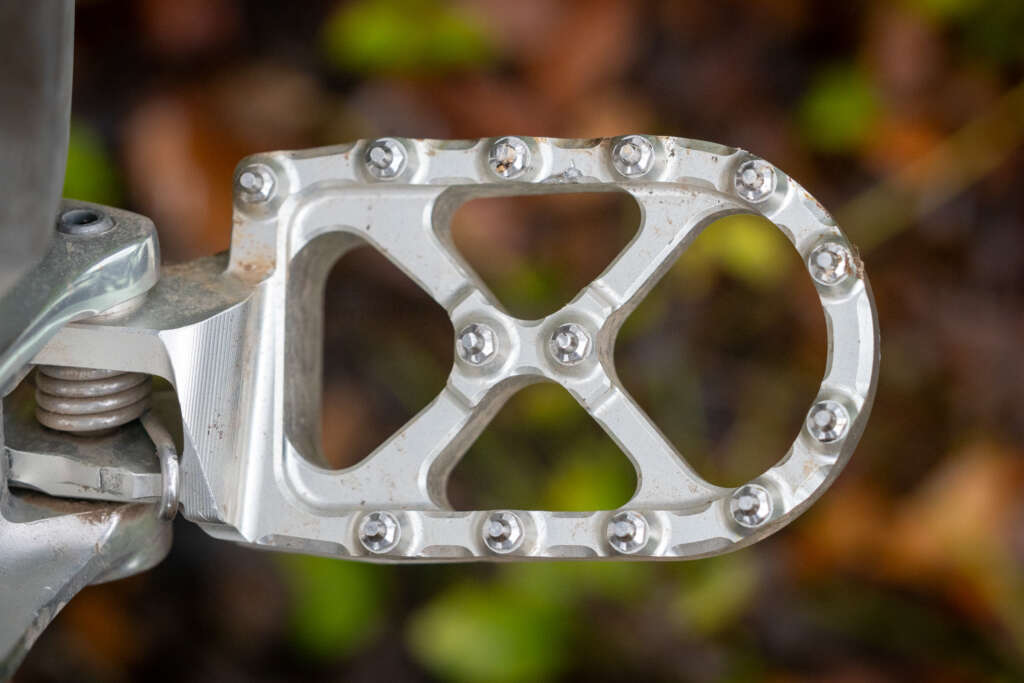
FLO’s Stark Varg foot pegs are machined from 7075 T6 aluminum and use removable stainless steel flat-top cleats. FLO lists the platform at 57 mm wide and 86 mm long. The cleats come pre-installed with Loctite, which I appreciated because many pegs with screw-in teeth make you install every little tooth yourself before you can even use them.
I tested the stock-position version, not FLO’s lowering peg. FLO does offer a lowering option for the Stark, but I am 5’11”, and the stock rider triangle on the Varg suits me very well. I didn’t feel the need to move the pegs; I just wanted a better feel in the same position.
Installation was a non-event. The pegs went right in with no fitment drama, filing, forcing, or alignment issues.
They Feel Bigger Than They Measure
This is where the review changed once I measured the stock pegs.
Based on feel alone, I would have sworn the FLOs were meaningfully wider than the OEM Stark pegs. They felt like there was more platform under my boots. But the stock pegs are already close enough in size that I would not call this a simple “wider peg” upgrade.
The bigger difference was feel.
The FLOs felt more solid underfoot. More planted. Less like a separate part hanging off the bike and more like I was standing on an extension of the frame. That was probably a mix of the peg body, the inward cant, the tooth layout, and maybe less flex than the stock pegs. I do not have a way to measure peg flex, so I am not going to pretend this is a lab result. But on the bike, they felt more rigid and more connected.
For the kind of riding I do, that stood out quickly.
Why That Feel Mattered
Much of my riding is on hard-packed surfaces with countless rocks and limited traction, plus ledges, awkward drops, and long dual sport rides where I stand for extended periods. I also tend to stand more than most riders I know. My feet are annoyingly sensitive from decades of testing rock climbing shoes, so small differences in pressure, support, and feel under my boots are extremely noticeable.
I get a lot of terrain feedback through my feet. The FLOs felt more secure and transmitted a more precise feel when I was standing, weighting the pegs, and absorbing bumps through my legs. They did not feel vague or springy underneath me. They felt solid.
That does not mean the stock Stark pegs feel bad. They do not. But the FLOs gave the bike a more planted and accurate feel through my feet, and that gave me more confidence when I was standing in rough terrain or when traction was limited.
The Inward Cant Helped
One of the better parts of these pegs was the inward cant.
I have always liked pegs that angle slightly toward the bike, but I haven’t felt that in a long time. I tend to focus more on squeezing my feet into the bike than clamping hard with my knees, even when I am seated. These pegs helped that naturally.
Some riders grip the bike more from the knees down. I tend to feel the bike from the feet up. The inward cant gave me a more natural connection through my ankles, calves, and knees without having to consciously squeeze as much, especially through my ankle and lower shin.
On the Stark, that was easy to notice because the bike already feels so smooth and quiet compared with a gas bike. Small contact points stand out more.
Grip Without Constant Filing
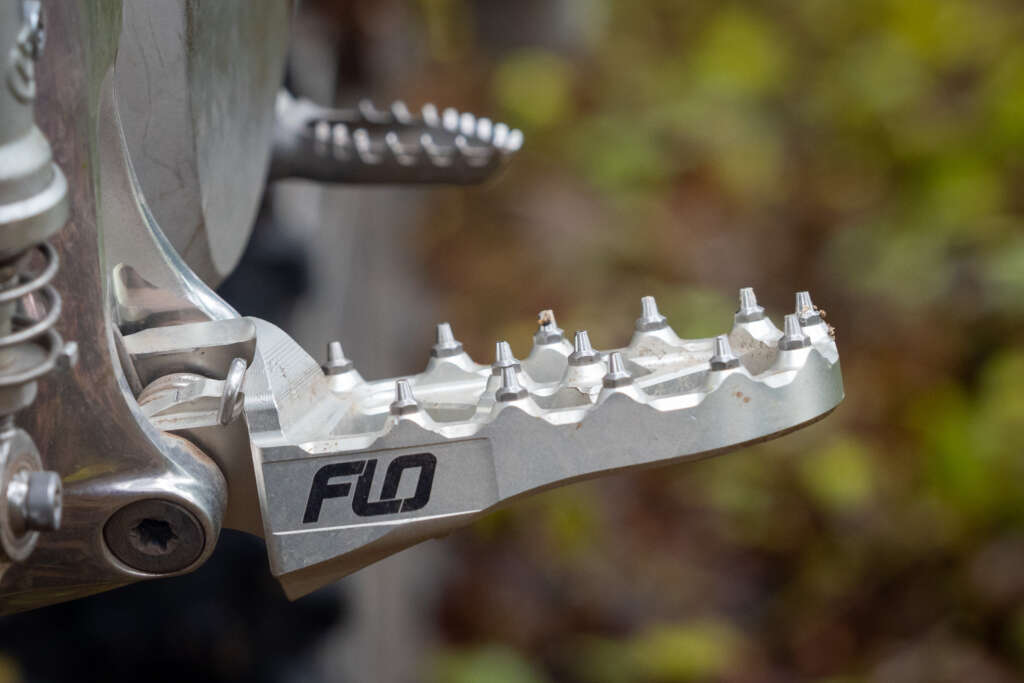
The FLO pegs use flat-top stainless teeth that screw into the platform. They didn’t feel like freshly filed titanium teeth, and they didn’t bite into the soles in that same razor-sharp way.
I noticed that at first. Then I realized they still had more grip than my stock pegs after normal wear, and they held that grip consistently over time.
That comparison makes the most sense to me. A perfectly sharp, freshly filed traditional titanium peg will bite harder. The FLO pegs do not beat that. But I don’t have the time or patience to file titanium pegs every time they stop feeling sharp. I would rather have a replaceable-tooth design that stays consistent without adding another maintenance job.
Compared with worn standard pegs, the FLOs gripped better. Compared with perfectly sharpened traditional titanium pegs, they do not bite as aggressively.
For me, that is a fair trade.
Sole Wear Is the Downside
The downside is boot-sole wear.
The FLO pegs were harder on my boot soles than the stock Stark pegs. They did not chew soles as badly as sharp, filed traditional pegs, but they definitely broke them down faster than a more rounded or normally worn standard peg.
I do not think there is a magic way around that. More bite costs rubber. Less bite saves soles but gives up grip.
I felt the added grip, more solid feel, and secure standing platform were worth it. Riders trying to make expensive boot soles last as long as possible may feel differently.
25 Hours of Use
I’ve ridden these pegs for 25 hours, and they have held up well.
They have been through hours-long trail rides, rocky hits, minor get-offs, and plenty of bike-on-rock abuse. The pegs folded when they were supposed to, and I have not seen bending, cracking, or anything that made me question them. They have surface scratches, but that is expected on foot pegs.
The teeth still feel like they have bite. They haven’t rounded into useless little nubs, and I haven’t felt the need to replace them yet. That matters because part of the appeal of this style of peg is consistency without constant filing.
Who They’re For
These make the most sense for a Stark rider who likes the stock peg position but wants a more planted, rigid, connected feel under the boot.
If you stand a lot and gather more information through your feet, or if you want the bike to feel more solid underneath you, the FLOs are worth looking at. If you like inward-canted pegs, they become even more interesting. That was one of my favorite parts of the design.
If you are expecting a dramatically larger platform than stock, that is not really the story. The stock Stark pegs are already close in size. The FLOs felt more substantial to me on the bike, but that came more from rigidity, cant, grip, and overall feel than a major dimensional change.
If you want the sharpest possible bite and are willing to keep filing traditional pegs, you may still prefer that style. If you are extremely sensitive to boot-sole wear, these may annoy you. And if you love the stock Stark pegs, I am not going to tell you they are bad just to justify an upgrade. They are good pegs.
The FLOs simply gave me a more solid, connected, and secure feel on the bike.
The Last Word
The FLO Motorsports Stark Varg foot pegs are not an upgrade that fixes a bad stock part. The stock Stark pegs are already very good, and they look incredible. But for the way I ride, the FLOs gave me something I wanted: a more planted feel under my boots, better grip than worn stock pegs, and a stronger sense of connection to the bike in technical terrain.
The stock-position fit was perfect. Installation was easy. The inward cant suited my riding style. The replaceable flat teeth gave me consistent grip without making me maintain razor-sharp teeth all the time. The only real downside was increased boot-sole wear, but that comes with almost any peg that grips better.
At $176.95, they aren’t cheap, but they aren’t outrageous for a quality aftermarket foot peg either. If you ride a Stark Varg and want replaceable teeth, inward cant, and a more solid and precise feel under your boots, the FLO Motorsports pegs are worth serious consideration.
